
EN


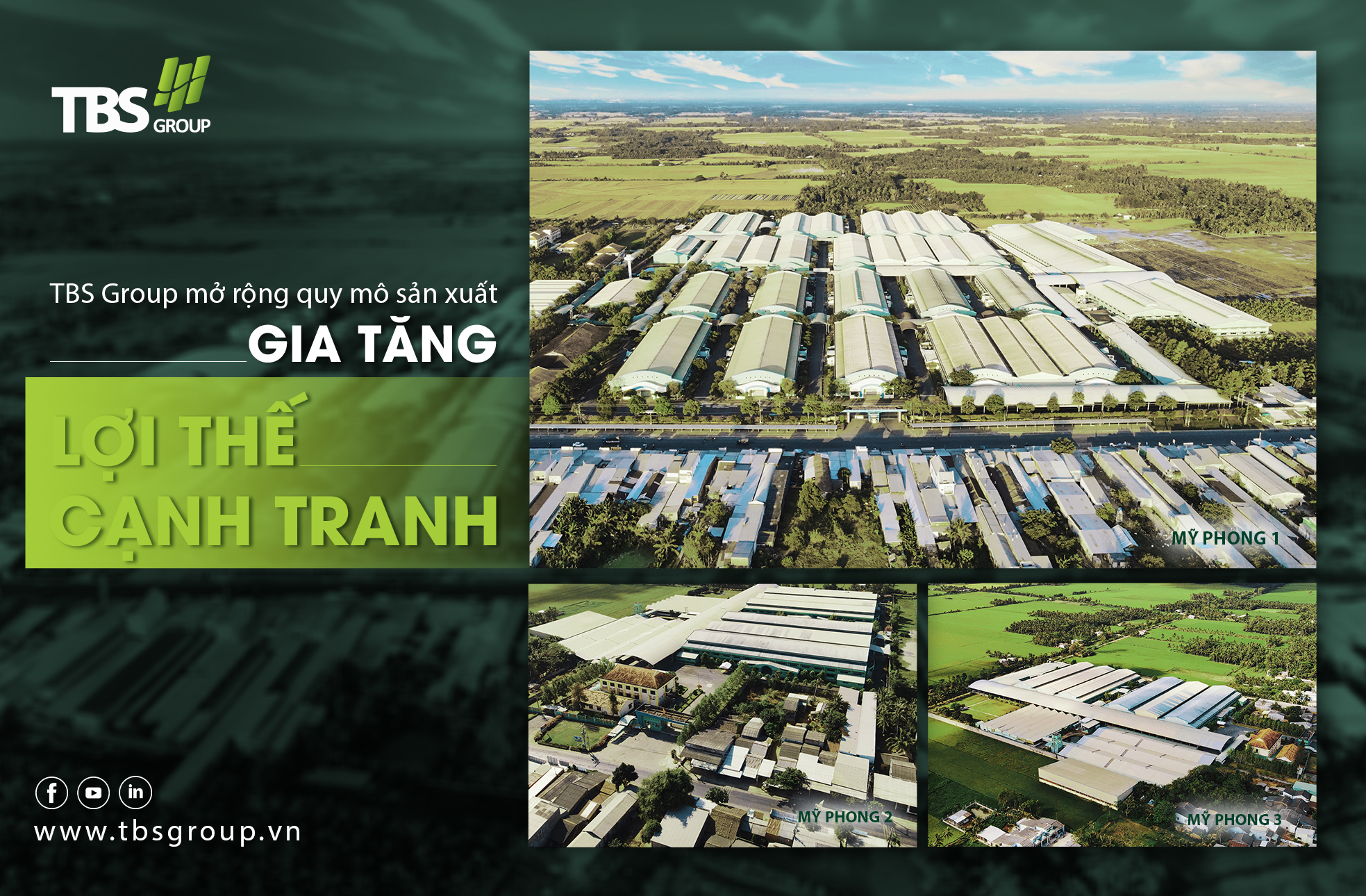
Over the years, TBS Group has consistently grown in both breadth and depth. Industrial production remains a crucial part of the group’s development strategy. Numerous large-scale factories have been established and put into operation, particularly in the Southwestern provinces of Vietnam, such as Kien Giang and An Giang. Most recently, in the first quarter of 2021, TBS Group officially integrated the My Phong factory (Tra Vinh province) into its footwear and handbag production chain, continuing to realize its goal of expanding production scale and enhancing its competitive capacity.
The Cost Advantage of Large-Scale Production
Expanding production scale is vital for a company’s economic interests, especially in the manufacturing sector. In economic terms, this is known as “economies of scale”—the cost advantages a business gains when it produces more efficiently. The larger the business, the more costs it can save. This is particularly evident in manufacturing.
“Economies of scale” fundamentally impact every business in any industry. For TBS Group, expanding production is a critical component of its goal to increase competitiveness based on both cost and production quality. This can be analyzed across five key economic benefits:
Of course, every issue has two sides. While expanding scale provides momentum for a business’s growth, it also means that operating costs increase and the management apparatus becomes more “cumbersome.” In this scenario, a long-term and sustainable development strategy is the key to a company’s survival and growth. This is precisely why TBS Group’s scale expansion is always accompanied by a restructuring process, in both breadth and depth.
Merging the My Phong Factory (Tra Vinh Province), TBS Group Prepares for a Breakthrough
Starting as a small enterprise headquartered in Binh Duong, TBS Group’s industrial production sector has undergone many transformations. From a company specializing in contract manufacturing women’s footwear, TBS Group is now positioned as a manufacturer of high-end leather, footwear, and handbags. Its production scale spans from the North to the South of the country, providing jobs for over 30,000 employees and making a significant contribution to the national economy.
The first step in expanding production beyond Binh Duong was the Song Tra factory in Thai Binh province. Following that success, TBS Group continued to “seek new lands,” such as TBS Dong Xoai (Binh Phuoc), TBS Kien Giang, and TBS An Giang. Its production capacity reaches tens of millions of products annually, including footwear, handbags, and supporting industries.
Most recently, TBS Group completed the final procedures to officially integrate the My Phong factory (Tra Vinh) into its system. This is considered a major milestone in the group’s production expansion, particularly in the Southwestern region.
Established in 2005 in Tra Vinh, My Phong covers a total area of over 53 hectares, comprising three facilities:
All three facilities have large-scale sports halls, cultural centers, and dormitories (equivalent to hotels) with a total of 224 rooms. In terms of production capacity, My Phong once recorded its highest output at 45 million products in 2015, with a peak workforce of up to 30,000 people.
It is clear that the merger of My Phong into the production system is of great significance for the future development of TBS Group. Especially during a period when COVID-19 continues to impact the global economy, combined with the shift of production waves from China, this will undoubtedly be a solid stepping stone for a spectacular breakthrough for TBS.
Along with the economies of scale, TBS Group’s competitive capacity will increase significantly, fully meeting customer demands in terms of quantity, quality, and cost.
Furthermore, the shift of production to the Southwestern provinces is part of TBS Group’s long-standing sustainable development strategy. With the policy of “leaving the farm, but not leaving the hometown,” TBS Group aims to provide abundant and stable employment for local workers. This improves the lives of residents, allowing them to stay in their hometowns instead of moving to large cities or industrial zones to find work, where the cost of living is high and related social issues are prevalent.
Conclusion:
The integration of My Phong into the TBS Group system is a tremendous effort by the leadership and is of great importance to the group’s development process. Despite the remaining difficulties and challenges, all TBS Group employees are determined to operate My Phong efficiently and productively, for the future of TBS Group and the lives of its workers.


